Frame the month-end question and inspect five sources
Import the SAP scenario and distinguish the role of each of its five source tables.
Question for this chapter
Which tables must be connected to explain revenue?
Why this matters now
Starting with a total from one table removes its customer and material context. First identify the role and join keys of the five sources so that you can later explain what each result means.
Try it
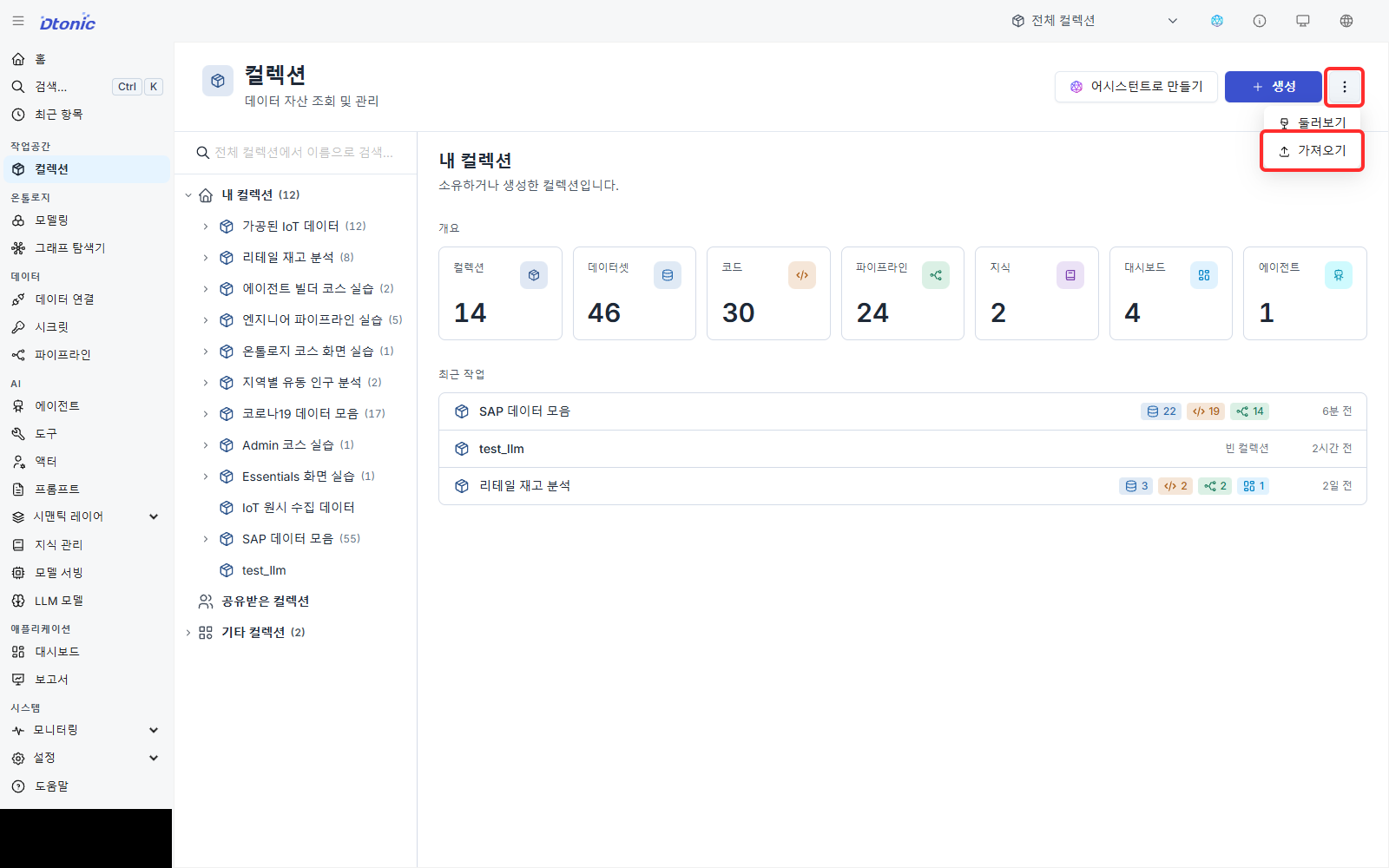
sap.zip Download(1.6 MB)Select Collections in the left sidebar, then choose More (⋯) → Import in the upper-right. Upload the ZIP and open the SAP Data Collection.
Open SAP Sales Document Header (VBAK) in the collection and select the Data tab.
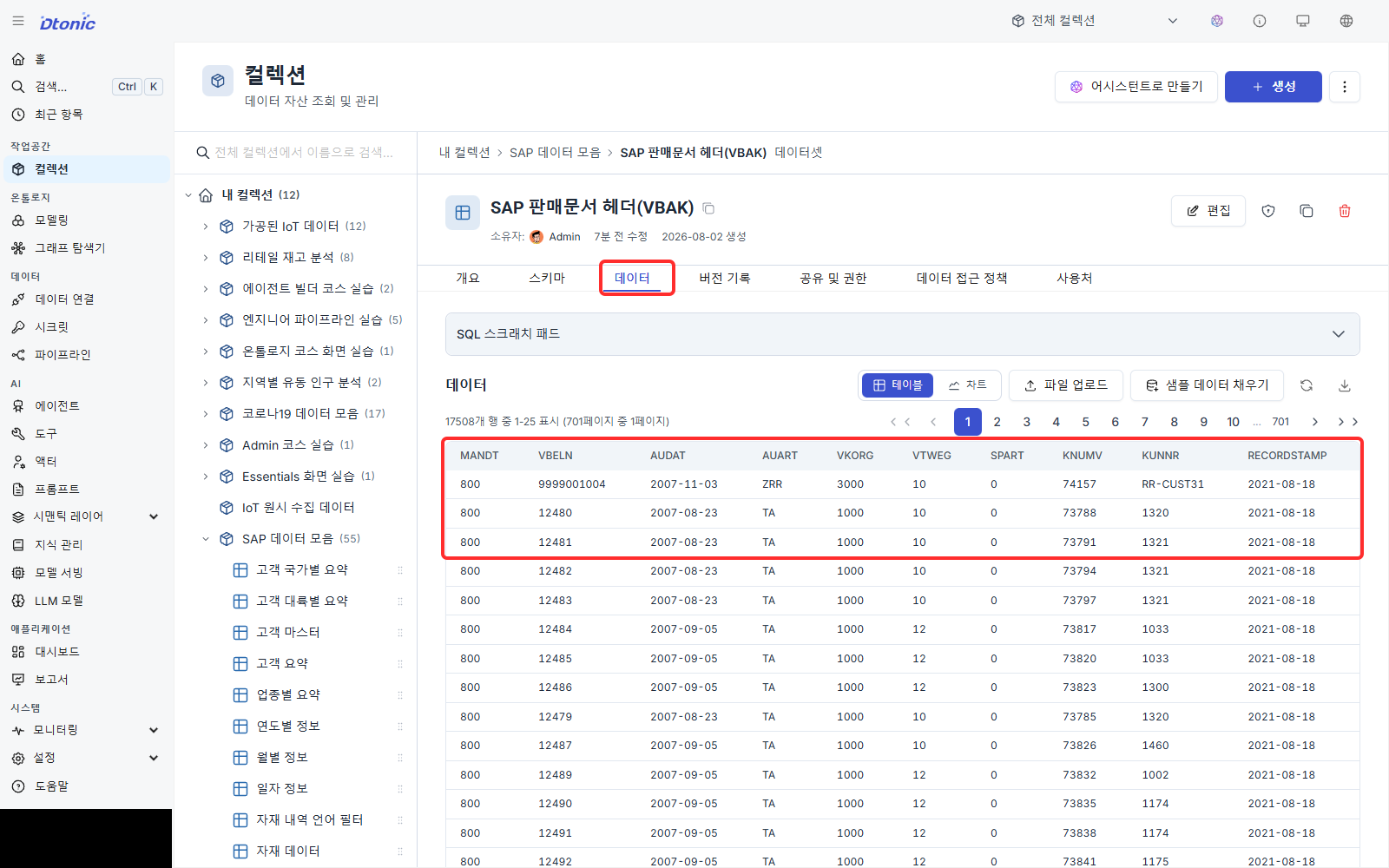
| Visible alias | SAP abbreviation | Role | Join key |
|---|---|---|---|
| SAP Sales Document Header | VBAK | Order header with date and customer | Order number |
| SAP Sales Document Item | VBAP | Material, quantity, and amount by order line | Order number, material number |
| SAP Material Master | MARA | Material type and base attributes | Material number |
| SAP Material Description | MAKT | Language-specific material name | Material number |
| SAP Customer Master | KNA1 | Customer name and region | Customer number |
Deep dive — complete imported asset inventory
| Asset type | Count | Contents |
|---|---|---|
| Collection | 1 | SAP Data Collection (sap) |
| Datasets | 22 | Five source datasets and 17 derived datasets rebuilt by pipelines |
| Code | 19 | Sales, material, and customer preparation; summaries; order review; ontology materialization |
| Pipelines | 14 | Execution paths from source preparation through order review and ontology materialization |
| Ontology | 1 model / 10 entities / 10 relations | Customer → order → line → material plus date and region hierarchies |
| Tool and Agent | 1 each | ontology_graph_query, sap_assistant |
The ZIP uploads files only to the five source datasets. The pipelines rebuild the other 17 datasets from those sources, so empty derived datasets immediately after import are expected.
Success looks like this
The SAP Data Collection contains the asset groups shown above, and the five source datasets contain data. Only those five source files are in the ZIP; the pipelines recreate every derived dataset.
Interpret the result
VBAK joins to VBAP by order number, VBAP joins to MARA and MAKT by material number, and VBAK joins to KNA1 by customer number. This is what lets one line amount acquire customer and material meaning.
Next decision
The source codes and labels are not yet ready for analysis. Next, prepare the sales, material, and customer domains separately.