Retail Inventory Intelligence
Act as a fictional inventory operator, connect branch inventory with competitor prices, and explain whether replenishment or price review should come first.
0/7 chapters complete
9:00 a.m. in a fictional inventory operations room
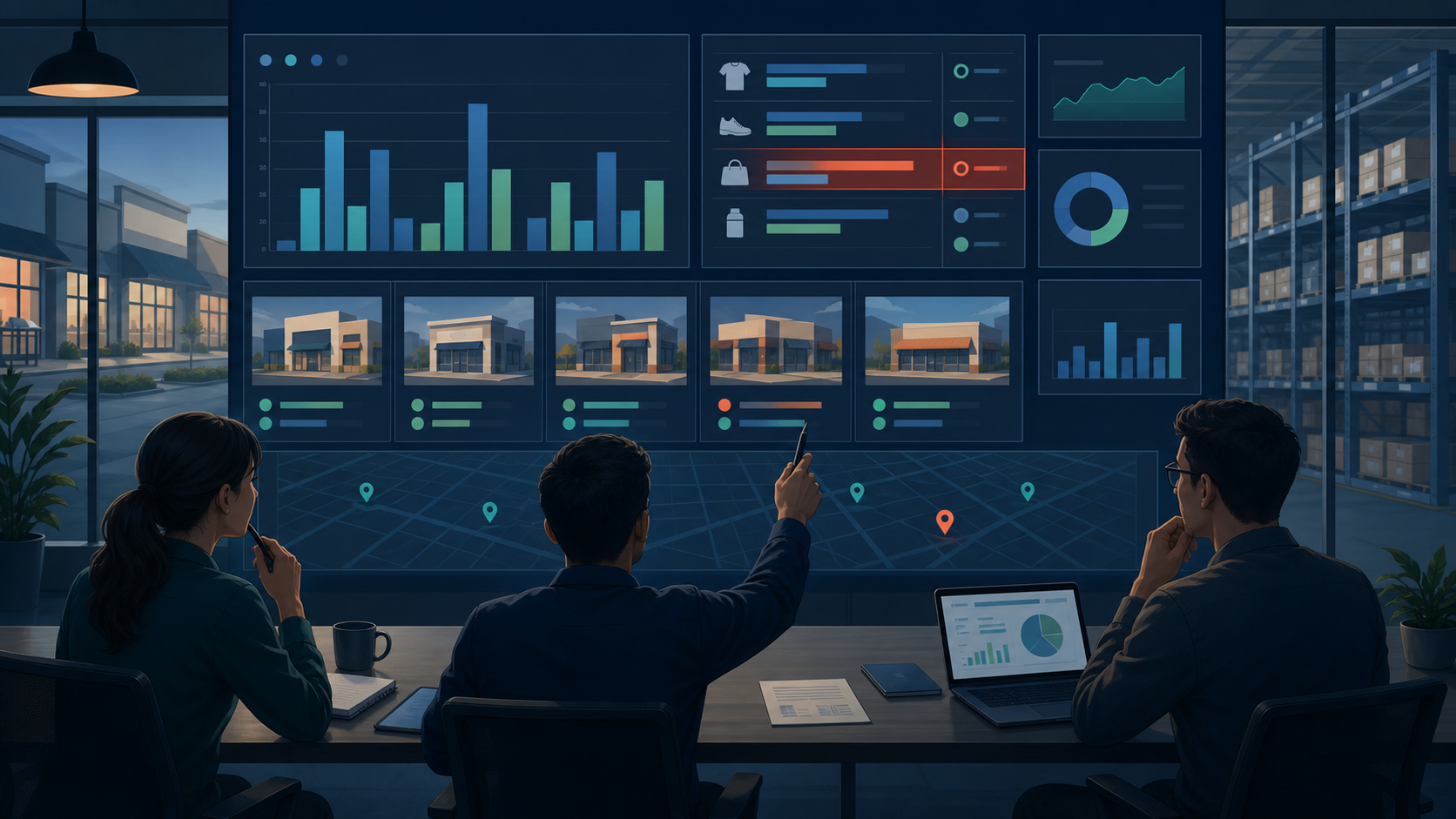
Inventory from several branches and a set of competitor-price observations have arrived together. The inventory operator must separate two questions instead of starting with whichever dashboard number is largest: Does anything need replenishment? and Does a product's price need review?
Which product at which branch should be replenished or reviewed for a price adjustment first?
Decision criteria for this mission
- Perspectives in play — Inventory operations watches for stockout risk, while pricing operations watches the gap to competitor prices. Both need one product-and-branch grain before agreeing on a first action.
- Decision constraints — The current synthetic seed has 0 stockout-risk rows and 36,805 price-review candidates. A price gap is a review signal, not an instruction to change price before checking observation time, product specification, promotion, and cost.
- Completion signals — Confirm the 46,700-row enriched result, narrow it to the branch-product pair with the largest gap, and report why price review comes before replenishment together with the hold conditions.
Workshop goals
- Explain the key that connects one product across two tables and the role of each price observation.
- Compare one row before and after a pipeline run to identify exactly what changed.
- Expand a product into branch, region, and supplier context for follow-up.
- Group dashboard signals into replenishment, price review, and additional verification.
- Report the first action for the current seed with supporting evidence.
Seven decisions
Loading the diagram. Mermaid source:
flowchart LR
    accTitle: Seven stages that turn inventory and competitor prices into a first response
    accDescr: Frame the operations question, enrich inventory with competitor prices, expand relationship context, choose the first dashboard action, check the evidence in a quiz, and explain the solution.
    question["1. Operations question"] --> align["2. Find the same product"]
    align --> enrich["3. Enrich the price"]
    enrich --> context["4. Expand relationships"]
    context --> decide["5. Choose the first action"]
    decide --> check["6. Check the evidence"]
    check --> explain["7. Retrospective"]
Every chapter follows question → reason → action → observation → interpretation → next decision. Open Deep dive in the first chapter only when you need the full inventory or implementation detail.
Prerequisites
- A D.Hub Portal account with Editor access or higher
- About 1.6 MB of download space for the scenario ZIP
- 90 minutes of practice time
You do not need a terminal, Python, or a repository clone. If import is new to you, complete Import and tour a complete hands-on scenario first.
Learning journey
- Start with today's inventory question15 minImport the current scenario and prepare to observe replenishment and price-review signals separately.
- Find the same product in two tables15 minCompare item_code and observed prices between Product Information and Competitor Price Data.
- Enrich inventory with the competitor price15 minRun the price-update pipeline and interpret one before-and-after row and the complete output scope.
- Expand a product into branch, region, and supplier context15 minMaterialize the enriched result as an ontology and inspect its operational relationships.
- Choose the response in the dashboard20 minRead widgets as replenishment, price-review, and verification evidence and select the first candidate.
- Check the inventory-decision evidence5 minBefore the final explanation, review the product key, price enrichment, relationship grain, and first action in four questions.
- Explain what you solved and finish the Workshop5 minReturn to the opening inventory question and summarize the first action and its evidence.