Start with the maintenance meeting question
Import the HS asset-management scenario and separate the four evidence layers needed to prioritize maintenance.
Question for this chapter
What evidence do we need to prioritize maintenance for ten assets?
Why this matters now
Starting with seven input datasets and five algorithms makes it easy to complete the runs without understanding how each output informs a decision. First separate current condition, remaining time, relationship context, and execution constraints.
Try it
hs_asset_management.zip Download(97 KB)Select Collections in the left sidebar. On the Collections page, select More (⋯) → Import in the upper-right corner and upload the ZIP. If validation reports no conflicts, select Start import and wait for completion.
Successful result
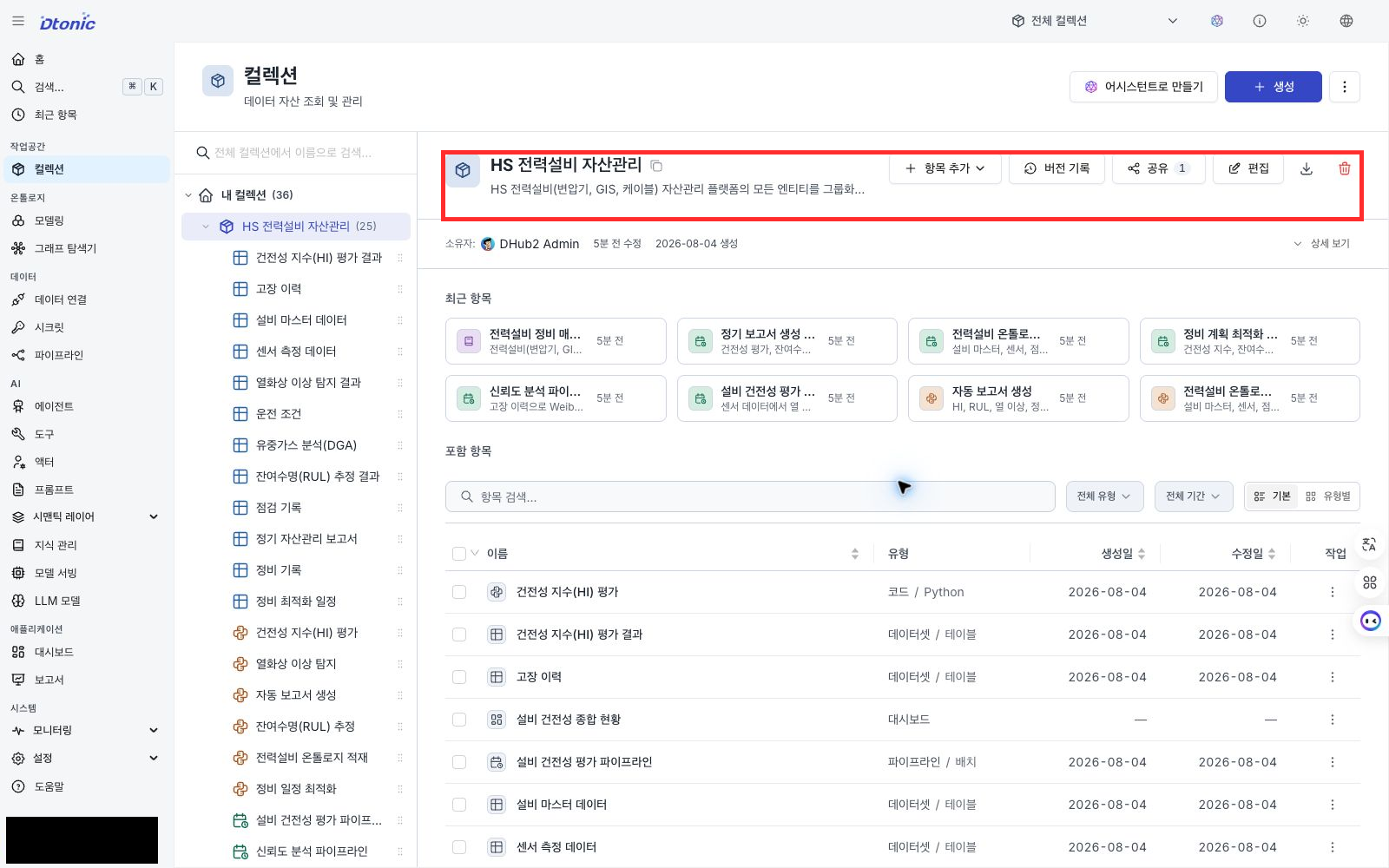
The collection tree shows hs_asset_management. Open equipment_master and confirm ten rows from
EQ-001 through EQ-010. The other six input datasets are populated, while the five output datasets
remain empty until you run their pipelines.
Read the result
The evidence needed for the first maintenance choice has four layers.
| Evidence | Question it answers | Asset to inspect |
|---|---|---|
| Current condition | What do several checks say about the asset now? | health_index_scores |
| Remaining time | What range follows from failure history and operating conditions? | rul_estimates |
| Relationship context | Which subsystems, sensors, and inspections connect to the asset? | hs_equipment ontology |
| Execution constraints | When can work fit within budget and daily crew capacity? | maintenance_schedule |
Deep dive — assets registered by the import
| Asset type | Count | Contents |
|---|---|---|
| Collection | 1 | hs_asset_management |
| Datasets | 7 inputs / 5 outputs | Equipment, sensors, inspections, maintenance, DGA, failures, operations / anomalies, HI, RUL, schedule, report |
| Code assets | 6 | Thermal anomaly, HI, RUL, schedule, ontology, report |
| Pipelines | 5 | Health, reliability, maintenance plan, ontology, periodic report |
| Ontology | 6 entities / 6 relations | Equipment, subsystem, sensor, inspection, defect, maintenance and their relations |
| Knowledge / dashboard | 1 each | Maintenance manual and equipment health overview |
The input row counts are 10 equipment, 1,000 sensor readings, 33 inspections, 20 maintenance records, 25 DGA samples, 33 failure-history records, and 500 operating-condition rows. Pipelines populate the outputs in the following chapters.
Next decision
You separated the evidence layers. Next, combine several condition clues for EQ-005 into one HI and
ask whether the lack of a thermal anomaly is enough to lower its priority.